



Navigating Visual Misinformation in the Age of Generative AI: From Pixels to Prompts
On 31 March 2026, the AI Media Centre (AIM) and Centre for Media and Communication Research (CMCR) at the School of Communication, Hong Kong Baptist University, hosted a distinguished session of its “CMCR Research Talks.” The guest speaker was Professor Cuihua (Cindy) Shen from the University of California, Davis, who delivered a lecture entitled “From Pixels to Prompts: Visual Misinformation in the Age of Generative AI.” The event took place at CVA1022 and attracted many faculty members, researchers, and students.
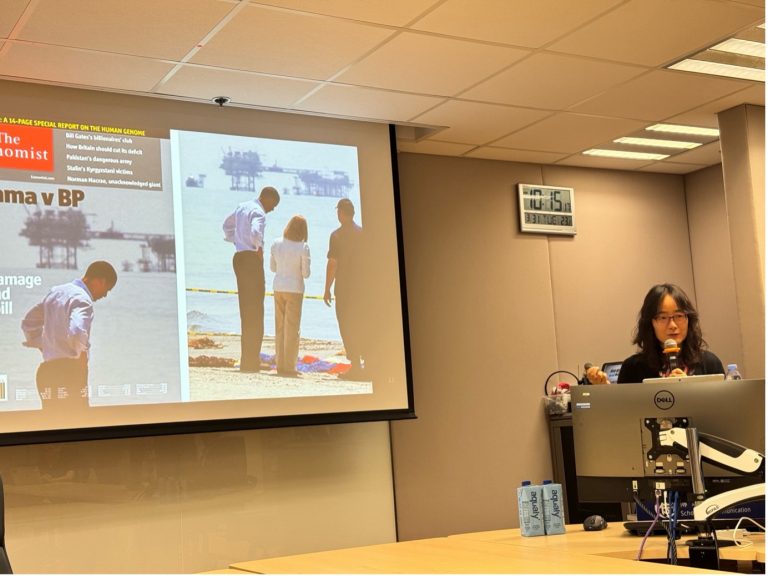
Professor Shen is a leading scholar in computational and multimodal communication and serves as Editor-in-Chief of the Journal of Computer-Mediated Communication. In her talk, she addressed the rapidly evolving landscape of visual misinformation amid the rise of generative AI. As digital environments become increasingly saturated with multimodal content—combining text, images, audio, and synthetic media—understanding how these signals shape public perception has become more urgent than ever.
She began by outlining the definition and typology of visual misinformation. Drawing on over a decade of research, she identified several key categories, including image composition (combining elements from different photos), retouching, elimination (removing visual elements), and misattribution (placing authentic visuals in misleading contexts). She also discussed the growing impact of AI-generated images and deepfakes, which have significantly lowered the technical barriers to producing convincing forgeries. Importantly, she emphasized that the credibility of visual content is inherently contextual and cannot be evaluated in isolation from accompanying text and platform cues. Professor Shen then shared findings from multiple empirical studies examining how people assess the credibility of visual posts. Her team’s large-scale experiments reveal that traditional source cues—such as media outlet reputation, platform type, or engagement metrics—have limited influence on perceived credibility. Instead, individual-level factors play a more decisive role. In particular, digital media literacy and prior attitudes significantly shape how users evaluate visual information. These findings have been replicated in recent studies, reinforcing concerns about the persistent vulnerability of audiences in today’s information ecosystem. The lecture also explored the role of large language models (LLMs) in analyzing credibility judgments. Professor Shen demonstrated that AI systems can closely approximate average human credibility ratings and help identify visual and textual features associated with perceived trustworthiness. While acknowledging the limitations of such models, she suggested that AI could assist in prioritizing content for fact-checking and research purposes. In discussing interventions, Professor Shen reviewed strategies such as media literacy education, inoculation approaches, fact-checking, labeling, and platform-based nudges. However, she noted that user-focused interventions often produce small and short-lived effects. She proposed that greater attention should be directed upstream—toward content generation and propagation systems—by strengthening platform accountability and institutional design.
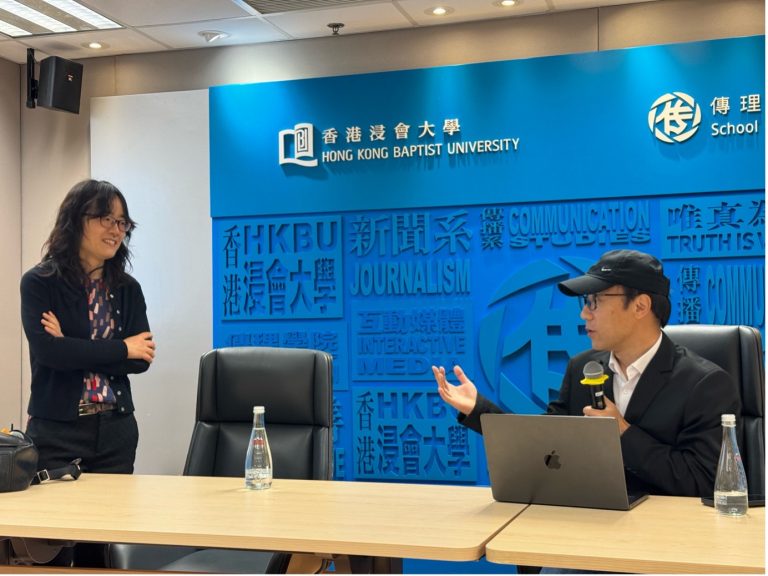
The lecture concluded with an engaging Q&A session, during which participants discussed platform responsibility, AI literacy, and the future of media education. The event provided timely insights into the challenges and possibilities of navigating visual misinformation in the age of generative AI.
Comments are closed, but trackbacks and pingbacks are open.